Immortality through death
The LoverImmortality through death is the paradoxical concept by which the younger brother’s death becomes more than a family loss: it reveals an immortality that had been hidden inside his living body, and whose destruction exposes the limits of every ordinary definition of permanence. For the Narrator, the revelation is not consoling. It arrives as pain, outrage, identification, and a compulsion to speak about what happened before the world can pass over it.
The Telegram and the Wound of Recognition
The concept is triggered by a telegram from Saigon announcing that the younger brother is dead, though the Narrator can no longer remember whether its formula said he was dead or had been “Recalled to God.” The uncertainty of the wording does not lessen the certainty of the event. She realizes immediately that the telegram could not have been sent by her mother, and the news first appears incomprehensible before pain comes from every direction and overwhelms her sense of self. She cannot initially determine whether this is the return of an earlier pain, connected with the child she had lost a few months before, or an entirely new pain; she eventually understands it as something new, a death that awakens a desire to die.
This recognition gives the younger brother’s death an existential force disproportionate to the external facts available about his life. The Narrator had been separated from him for ten years and had hardly thought about him, yet she discovers that her love had endured outside conscious recollection. The shock therefore reveals not simply that he mattered, but that attachment can remain active while hidden from the person who carries it. Immortality begins here as belated knowledge: what seemed absent was present, and what seemed ordinary contained an existence whose value had not been recognized in time.
The Body as the Site of Immortality
The Narrator describes the death as a cosmic mistake. Her younger brother was immortal, she says, and no one had noticed. Immortality had been concealed in his body while he was alive; only after the body died did the concealment become visible, and then immortality died with it. The world nevertheless continued without that body and without the visitation it had carried. This continuation is precisely what makes the event an outrage: the universe remains in motion after an incomparable presence has vanished, as if the error were both total and ignored.
The concept rejects the idea that immortality means an endless extension of time. The Narrator insists that immortality is mortal, that it can die, and that it does not announce itself while it is being lived. It exists not as a measurable duration but as a singular condition of life, something that belongs at once to spirit and to the pursuit of the void. It cannot be reduced to the claim that it has neither beginning nor end, nor to the claim that it begins and ends with spiritual life. The dead sands of the desert and the dead bodies of children mark the point at which the path of immortality stops and must seek another way.
The Younger Brother’s Singular Form
The younger brother’s immortality is described as flawless, unspoken, smooth, pure, and unique. These terms are deliberately placed against his apparent lack of accomplishment. He had nothing to say in the wilderness or anywhere else; he was uneducated, never learned successfully, could scarcely speak, read, or write, and sometimes seemed unable even to suffer. He was someone who did not understand and was afraid. The concept therefore refuses to make immortality depend on education, eloquence, achievement, or public recognition.
His very inability to explain himself becomes part of the mystery. Because he leaves no articulated doctrine and no conscious claim to greatness, the immortality attributed to him cannot be treated as a possession he knowingly cultivated. It is an intensity of being that existed without commentary and without self-interpretation. The younger brother did not know the name of the immortality he had harbored during the twenty-seven years of his life. Death makes the Narrator name what life itself could not disclose.
Death as Contagion and Identification
After the younger brother’s death, the Narrator imagines death as a chain reaction beginning with the child. Everything must die after him and through him, while his corpse remains unaffected by the events it has caused. This formulation transforms a single death into a principle that reorganizes the entire world. The younger brother does not act after death in any literal sense; rather, his death changes the Narrator’s perception so completely that every subsequent relation to life becomes marked by mortality.
The decisive identification comes when the Narrator understands that her younger brother’s body was also hers. From that knowledge she concludes that she must die, and declares herself already dead. The statement is not presented as a medical or chronological fact but as the consequence of recognizing a shared condition of embodiment. His death has entered her own body and identity, making separation impossible. The younger brother’s immortality is thus transmitted paradoxically through loss: it survives not as his continued physical existence, but as the knowledge that his death has permanently altered the living person who remembers him.
Writing, Witness, and the Limits of Permanence
The Narrator believes that people ought to be told and taught that immortality is mortal. The imperative to tell turns grief into testimony. What happened must not remain merely a private catastrophe, because the concealed nature of immortality is itself a general human danger: people may harbor it without knowing, while others may detect it only under the same condition of ignorance. The concept is therefore not a promise of rescue from death. It is a demand that life be understood while it is still alive, before its singular force is mistaken for something ordinary.
This demand also helps explain why writing appears as the future beyond the Narrator’s present despair. Earlier, while imagining an existence marked by solitude and an expansive desert of time, she sees that she will write. Writing cannot restore the younger brother’s body or reverse the universal mistake, but it can preserve the recognition that his life contained what no one had seen. In that sense, narration becomes the “other way” sought by immortality after death: not bodily continuation, but the difficult survival of an apprehended singularity in language, memory, and the reader’s act of witnessing.
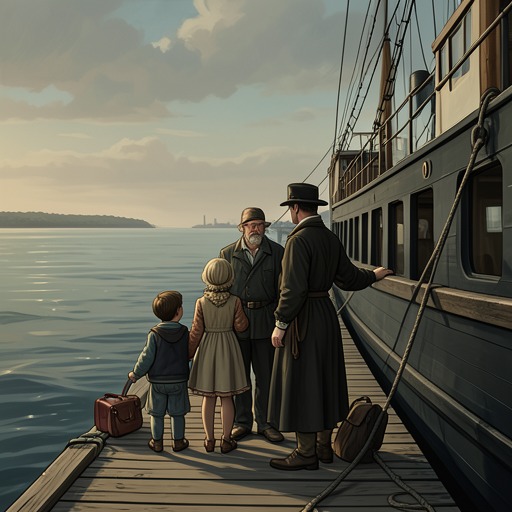
The concept also gains force through the book’s recurring threshold scenes. The first image is fixed on a ferry crossing the Mekong River, where the fifteen-and-a-half-year-old Narrator enters a new relation to the Chinese man from Cholon; later, the black car carries her away from the boarding school, and she returns at night to Hélène Lagonelle under the scrutiny of the school’s lights. At the end, the ship’s long siren calls accompany departure, while years later a telephone call in Paris allows the former lover’s voice to cross the distance again. These crossings do not defeat separation or time. They show instead how lives persist through altered forms—image, pain, bodily memory, voice, and writing—while remaining vulnerable to disappearance. Immortality through death names that unstable persistence: life becomes most legible as singular and irreplaceable precisely when death has made its continuation impossible.